
01
Reduce operational risk
Find exposed identities, weak authentication, public sharing, risky OAuth access and missing email controls.
Evidence and affected objects sit next to every finding.
TenantOne turns Google Workspace configuration data into a prioritized view of security, governance, AI readiness and cost—then packages the evidence for the people who decide what happens next.
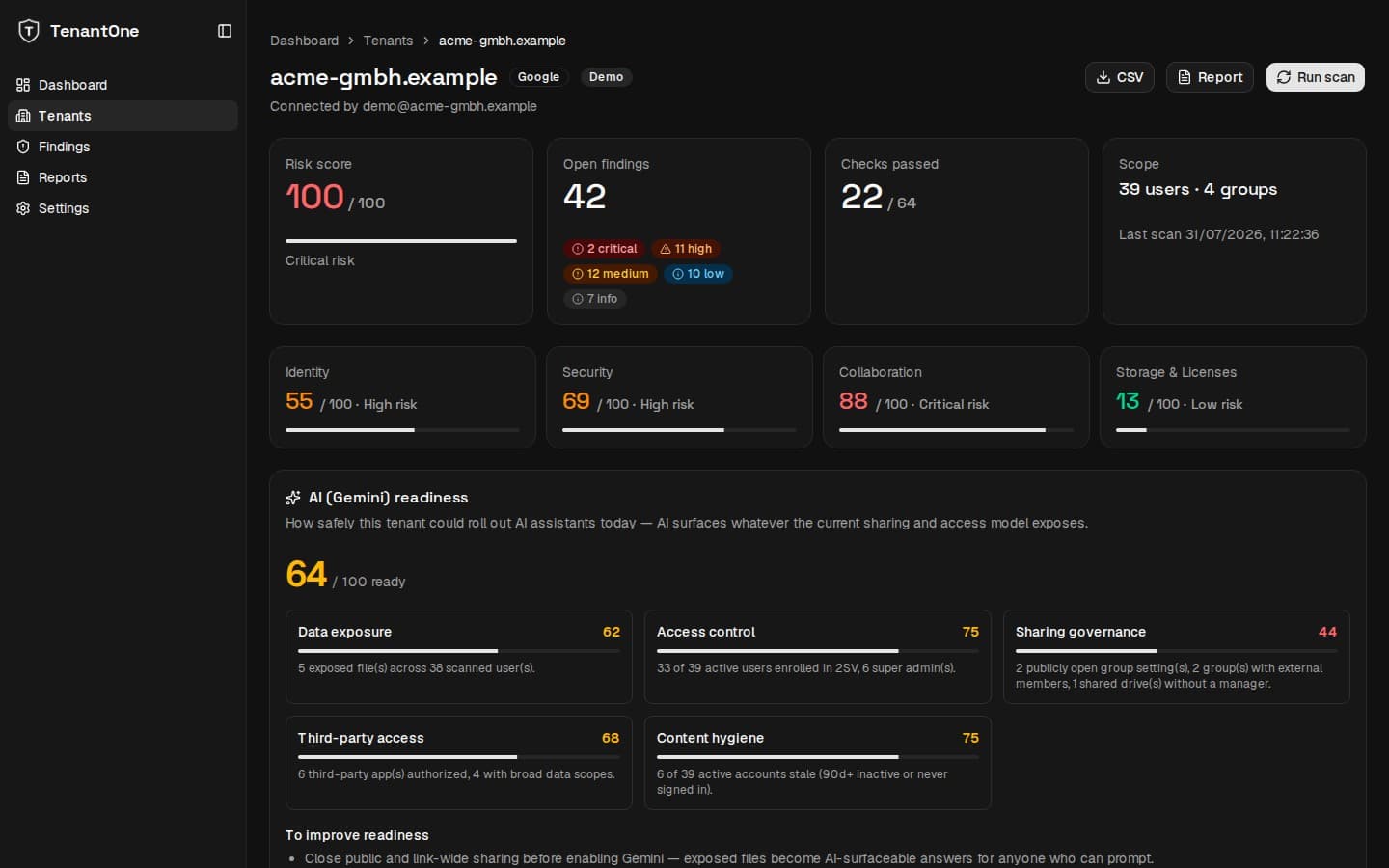
Security teams get evidence. Finance gets a savings signal. Leadership gets one report that makes the next decision easier.
Find exposed identities, weak authentication, public sharing, risky OAuth access and missing email controls.
Evidence and affected objects sit next to every finding.
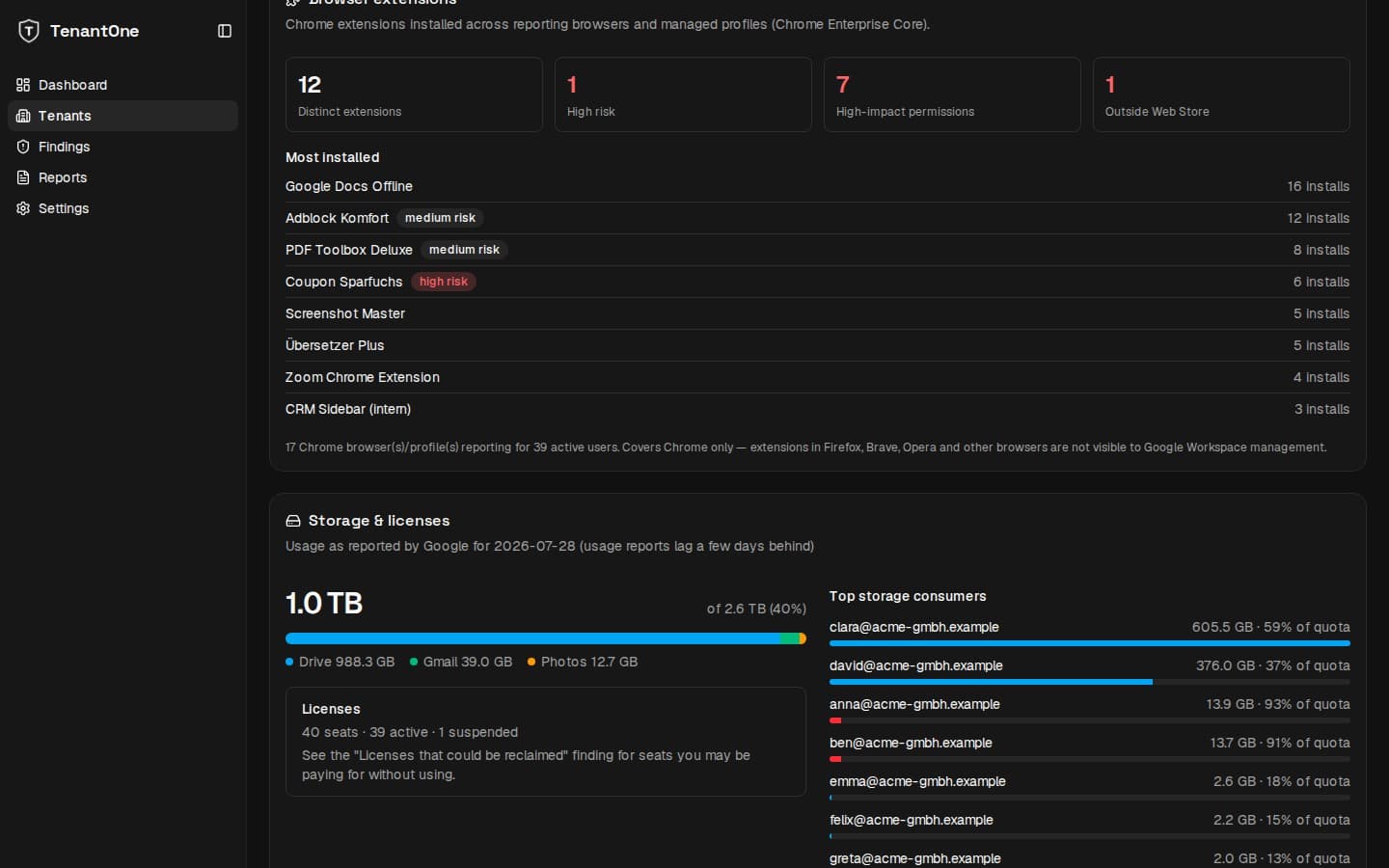
Surface reclaimable seats, storage pressure, stale large files and the users consuming the most capacity.
Turn observed waste into an annual planning estimate.
Measure the access and sharing model that Gemini will inherit before AI makes existing exposure easier to reach.
Five readiness pillars connect the score to concrete actions.
A single tenant score opens into four operating views, severity-ranked findings and the affected users, groups, applications or resources behind them.
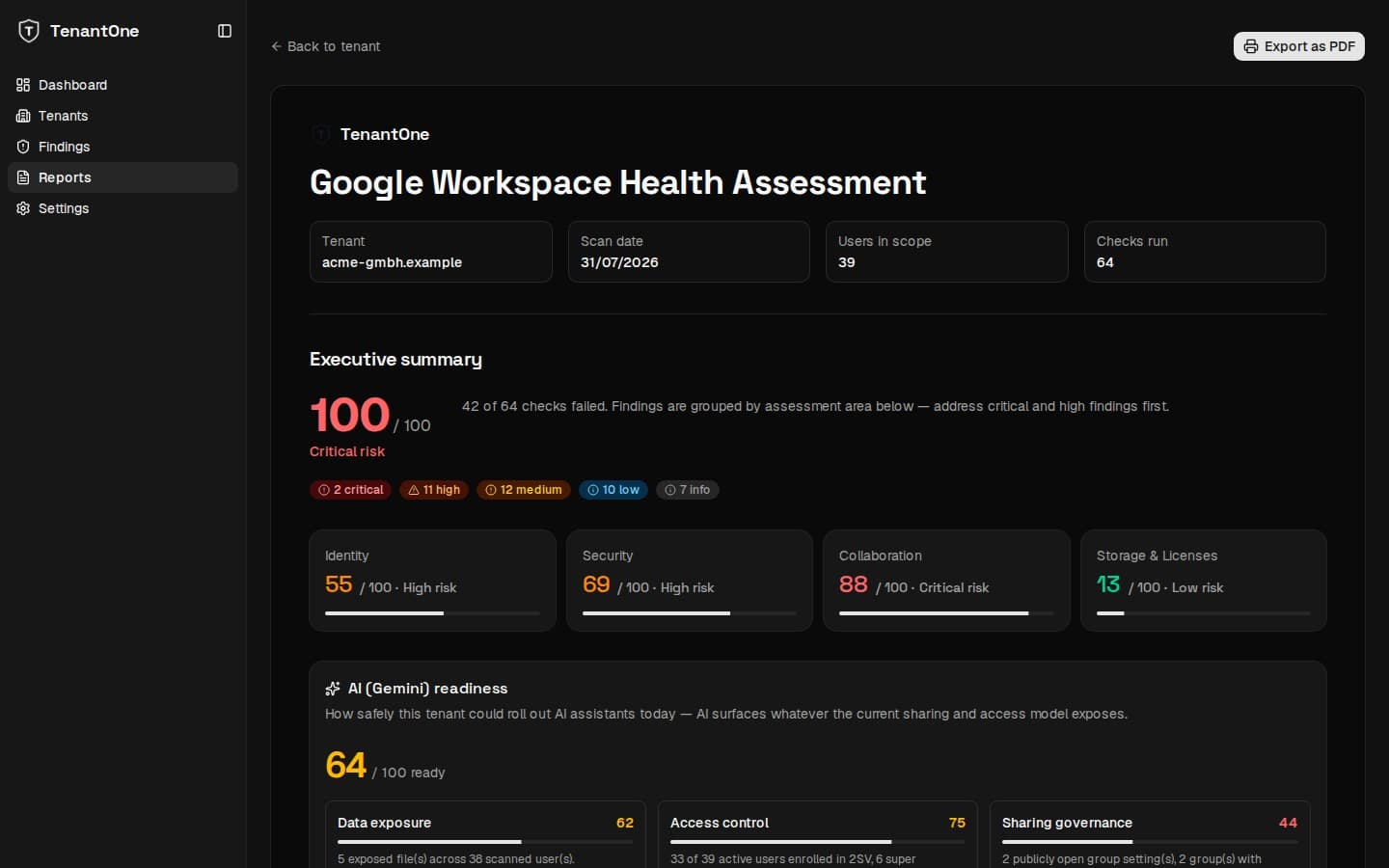
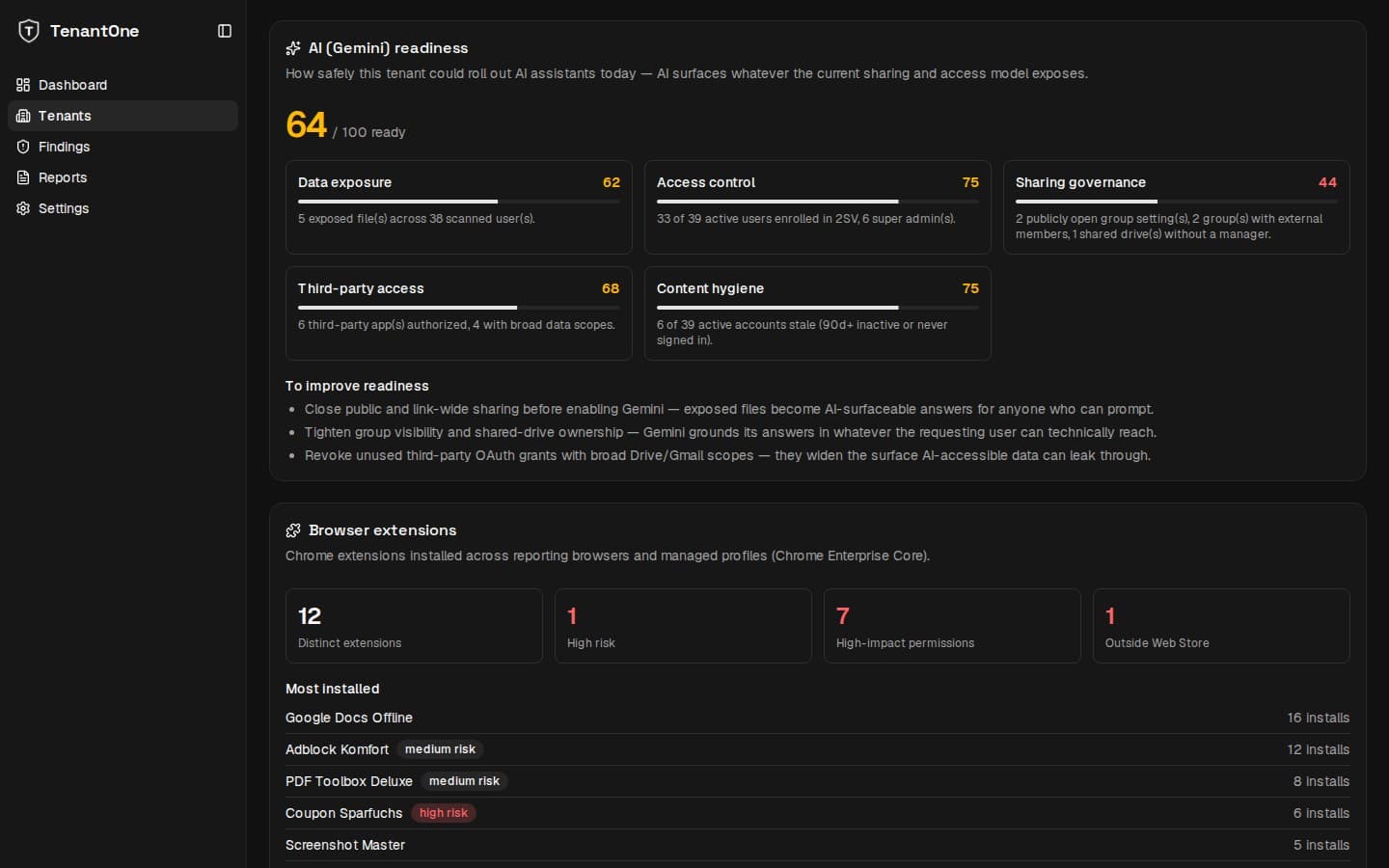
TenantOne packages existing Google Workspace governance signals into a five-pillar Gemini readiness view—without inspecting prompts or model output.
Public and link-wide file exposure where metadata coverage is enabled.
2-Step Verification and administrator posture.
Groups, external membership and Shared Drive ownership.
OAuth application sprawl and broad data scopes.
Inactive accounts and stale content signals.
The assessment connects unused seats and archivable storage to administrator-entered prices. The result is a transparent planning estimate—not a promised saving.
Seat × price × 12
Annual license estimate
Age × size
Storage opportunity
License findings are grouped by SKU, including Archived User opportunities for suspended accounts. Estimates stay explicit about entered prices and available metadata.
Optional-source checks are skipped when their evidence is unavailable. Missing coverage is never converted into a false pass.
Inactive accounts, administrators, recovery posture and 2-Step Verification.
Third-party OAuth grants, broad scopes and recent authentication events.
SPF, DKIM, DMARC, MTA-STS, suspicious activity and policy signals.
Google Groups, public links, external members and Shared Drive ownership.
SKU-level license assignments, seat utilization, top consumers, mailbox size and archival opportunities.
Managed mobile and ChromeOS devices, Chrome extensions, risky permissions and visibility gaps.
Included in the core read-only assessment.
Included in the core read-only assessment.
Included in the core read-only assessment.
Included in the core read-only assessment.
Included in the core read-only assessment.
Included in the core read-only assessment.
Included in the core read-only assessment.
Included in the core read-only assessment.
9 checks use an additional data source.
5 checks use an additional data source.
4 checks use an additional data source.
5 checks use an additional data source.
10 checks use an additional data source.
The same evidence is shaped for remediation, executive review and partner-led customer conversations.
A single 0–100 tenant risk score
Scores for identity, security, collaboration and storage
Critical and high findings prioritized first
Gemini readiness with five evidence-backed pillars
Key metrics and annual savings estimates
Recommended actions for owners and partners
Every phase is separated by the authorization and assurance it requires. That keeps current coverage clear and future expansion deliberate.
Read-only Google OAuth, automated checks including managed devices and SKU-level licenses, area scores, findings, scan history, CSV export and a PDF executive report.
Drive metadata, Shared Drives and managed Chrome reporting through separately authorized domain-wide delegation.
Delegated-role detail, administrator policy posture and selected alert sources.
Gmail settings, labels, DLP and retention evidence where demand justifies the additional assurance process.
Roadmap items describe product direction, not committed release dates. Availability depends on Google approval, customer edition and source-system configuration.
TenantOne is designed as an assessment layer—not another administrator making silent changes in your environment.
Administrators connect through Google OAuth. Passwords never pass through TenantOne.
The assessment observes configuration and metadata; it does not remediate or change settings.
Drive coverage uses metadata for sharing, ownership, age and size—not document contents.
Edition requirements, unavailable APIs and skipped checks remain visible in the result.
Explore the synthetic demo first. Review the checks, evidence, scores and executive report before connecting a tenant.